Once upon a time, there was a little girl. When she was about six, she walked to the video rental store down the street and came home with a VHS of a movie called The Empire Strikes Back.
"I got Star Wars," she said to her mom and dad.
"Oh, Empire?" they said. "You go ahead and watch it honey, but we don't feel like it right now."
So she did. And she fell in love.
By bedtime, she wanted to be Han Solo -- only, a girl.
She was a nerdy kid, consuming books and movies as fast as she could get her hands on them. Star Wars was an early love, but neither the first nor the last.
She had always wanted to be Robin Hood (ooh de lally!) -- only, a girl.
A few years later, still a kid, she wanted to be Taran of Caer Dallben -- only, a girl.
She wanted to be Captain Jean-Luc Picard -- only, a girl.
She wanted to be Indiana Jones -- only, a girl.
She wanted to be Aragorn -- only, a girl.
She even kind of wanted to be Captain Jack Sparrow -- only, a girl.
Still, the world moved on apace and "genre" fiction, will it or not, had to come along with. Dragged kicking and screaming, sometimes, but still.
She grew up. By her late twenties, finally, she got to be Commander Shepard -- who, as far as she was concerned, was only ever a girl.
And in her thirties, she had a baby: a daughter. And two years after that, someone made a new Star Wars movie, and she went to see it.
And the hero was a woman named Rey: not "only" a girl. A badass. A main character. A self-saving woman with a staff and a brain and the power and will to use both.
And the woman's heart was glad, for the little girl she had been, and doubly so for the one she was raising. Who, if she could help it, would never be "only a girl."
Showing posts with label gender issues. Show all posts
Showing posts with label gender issues. Show all posts
Monday, December 21, 2015

Thursday, February 21, 2013
Another Day, Another Press Conference
This isn't even about the PlayStation 4 at all, actually. My opinion on that is currently irrelevant: it seems like a PC circa 2011, only it can't also run productivity software. It'll be six months before the details that matter are available for me to form a strong opinion. We'll probably end up with one in the house in 2014. That is neither here nor there.
This is about the press conference at which Sony announced the PlayStation 4.
Sony's big problem: diversity. The vast majority of presenters on-stage were white men, a huge percentage of whom were even sporting the same haircut and glasses. The exceptions were a small handful of Japanese businessmen. Naturally, the circles I hang out in on Twitter took exception to this. When Patricia Hernandez gave it a mention on Kotaku, the predictable troglodytes crawled out of the woodwork to leave nasty comments.
One jerk, though, nailed the actual problem without even realizing he had. In trying to explain why everything Patricia wrote was an invalid complaint, he said: "The reason there were no women on-stage is because the presidents and developers who happened to develop the software being presented happened to be male. It is not part of some sexist agenda, it just so happens that the people behind the creation of the content being presented happened to be men."
DING DING DING DING DING.
This is, in fact, exactly the problem. There are no women in leadership at Sony and, if there are, SCE does not feel comfortable bringing them into presentations or the public eye. In fact, I can't recall ever seeing a woman executive presenting for Sony, despite the fact that many of their best game franchises and studios have very high-ranking women making them. So why, in 2013, is Sony still so resistant to having women in its top echelons? I refuse to believe that, worldwide and especially in the Americas, there are no competent female executives -- except for that the systems that generate executives continue to favor a very narrow spectrum of men.
I have no love for Microsoft or for the 360, but during their major press conferences at E3 and so on, they almost always have women on stage at some point, even if they are generally presenting non-gaming, non-"core," family-friendly tools and features.
I am sure that most of the men on stage were perfectly lovely fellows. But the narrowness of that particular slice of humanity really hit home when one came on stage to introduce what was later revealed to be a new inFamous game. "In 1999, I got tear gassed at a protest," he began his story, which went on to feed in to the current era of paranoia. The cops, it turns out, aren't always 100% good.
Really.
You don't say.
I'm sure there is no population out there who could have told you that. Every day. For the last century.
The statement was not ill-intentioned; far from it. It was naive, and came from a place of privilege, from one very specific outlook. It was a statement from a guy born into a population that doesn't routinely have trouble with cops, TO a population that doesn't routinely have trouble with cops.
And that's the kind of statement that comes out of a really, really narrow outlook. When everyone looks the same and shares the same life experiences, nobody's going to introduce a new perspective into a presentation. So you get more of the same, designed for the same people, even as the audience gets continually more diverse in every way.
What happens next? I guess that's up to Microsoft, and we find out at E3.
This is about the press conference at which Sony announced the PlayStation 4.
Sony's big problem: diversity. The vast majority of presenters on-stage were white men, a huge percentage of whom were even sporting the same haircut and glasses. The exceptions were a small handful of Japanese businessmen. Naturally, the circles I hang out in on Twitter took exception to this. When Patricia Hernandez gave it a mention on Kotaku, the predictable troglodytes crawled out of the woodwork to leave nasty comments.
One jerk, though, nailed the actual problem without even realizing he had. In trying to explain why everything Patricia wrote was an invalid complaint, he said: "The reason there were no women on-stage is because the presidents and developers who happened to develop the software being presented happened to be male. It is not part of some sexist agenda, it just so happens that the people behind the creation of the content being presented happened to be men."
DING DING DING DING DING.
This is, in fact, exactly the problem. There are no women in leadership at Sony and, if there are, SCE does not feel comfortable bringing them into presentations or the public eye. In fact, I can't recall ever seeing a woman executive presenting for Sony, despite the fact that many of their best game franchises and studios have very high-ranking women making them. So why, in 2013, is Sony still so resistant to having women in its top echelons? I refuse to believe that, worldwide and especially in the Americas, there are no competent female executives -- except for that the systems that generate executives continue to favor a very narrow spectrum of men.
I have no love for Microsoft or for the 360, but during their major press conferences at E3 and so on, they almost always have women on stage at some point, even if they are generally presenting non-gaming, non-"core," family-friendly tools and features.
I am sure that most of the men on stage were perfectly lovely fellows. But the narrowness of that particular slice of humanity really hit home when one came on stage to introduce what was later revealed to be a new inFamous game. "In 1999, I got tear gassed at a protest," he began his story, which went on to feed in to the current era of paranoia. The cops, it turns out, aren't always 100% good.
Really.
You don't say.
I'm sure there is no population out there who could have told you that. Every day. For the last century.
The statement was not ill-intentioned; far from it. It was naive, and came from a place of privilege, from one very specific outlook. It was a statement from a guy born into a population that doesn't routinely have trouble with cops, TO a population that doesn't routinely have trouble with cops.
And that's the kind of statement that comes out of a really, really narrow outlook. When everyone looks the same and shares the same life experiences, nobody's going to introduce a new perspective into a presentation. So you get more of the same, designed for the same people, even as the audience gets continually more diverse in every way.
What happens next? I guess that's up to Microsoft, and we find out at E3.
Thursday, January 10, 2013
I am not a racecar; I am not a man.
Kill Screen posted a single quotation today, and it struck me quite deeply. From a Monopoly expert:
"It's very seldom that you see a player not care about what token represents them on the game board."
That's it. One sentence. And that sentence is about, quite literally, Monopoly game pieces. And yet, in a certain way, it's one of the most revealing and useful things I've ever seen written about games.
The speaker, Monopoly expert Philip Orbanes, is right, of course. Any of us who has ever played the game, particularly in childhood, knows the ritual.
"I call the thimble!"
"Dibs on the dog!"
"The racecar is mine!"
(Nobody ever wants the iron.)
The game world of Monopoly is in some ways as abstract as they come. Its colorful painted squares represent streets, avenues, neighborhoods; they represent socioeconomic strata and an insurmountable class and economic system. Those little pewter-toned chunks of daily life we steer in circles 'round the board are our avatars, representing us as we navigate this world. Even in a system this abstract, avatar representation matters.

It's like living in a world where the only Monopoly token one is allowed to choose is the racecar. I don't want to be the racecar. I took the racecar because it was the only option given to me, after everyone else involved had their say first, and decided my outlook didn't matter.
The story of the racecar has gotten boring. I don't care how well-written a profile is; I am tired of the story of the man who wanted to find a girlfriend. I don't care how well-written the supporting or alternate cast is; I am tired of them not being front and center. I don't care about all of the daddy issues that show up in every damn game; I want a dramatic story about mothers. Or women. Or anything new at all, really.
 |
| Box art: Halo 4; Mass Effect 3; BioShock Infinite |
Everyone seems to understand, instinctively, that it's okay to have strong feelings about your Monopoly piece. From a young age, we got passionate about the dog, or the car, or the shoe (but never the iron), and that was all right. So why does similar passion about digital avatars create such a hue and cry? If you say you are tired of the slate of straight white men, you are a whiner. You do not understand that "sex sells." You are a troublemaker. You are a "feminist bitch" and worse.
I am not a racecar.
I am not a man.
I am tired.
Wednesday, December 19, 2012
In which I develop an opinion on Capcom
I really had no particularly strong feelings on either Capcom or on their upcoming Devil May Cry game until today.
But then, via Samit Sarkar, there was this.

That, right there, is the Christmas card that Capcom PR sent out this year.
Not only is Dante--that charming fellow on the left, there--surrounded by angels, but the angels are, of course:
Wow.
I didn't care about Capcom until now. But as of today, they're on my personal shit list--there to remain, I suspect, more or less permanently.
Well done, Capcom PR!
But then, via Samit Sarkar, there was this.
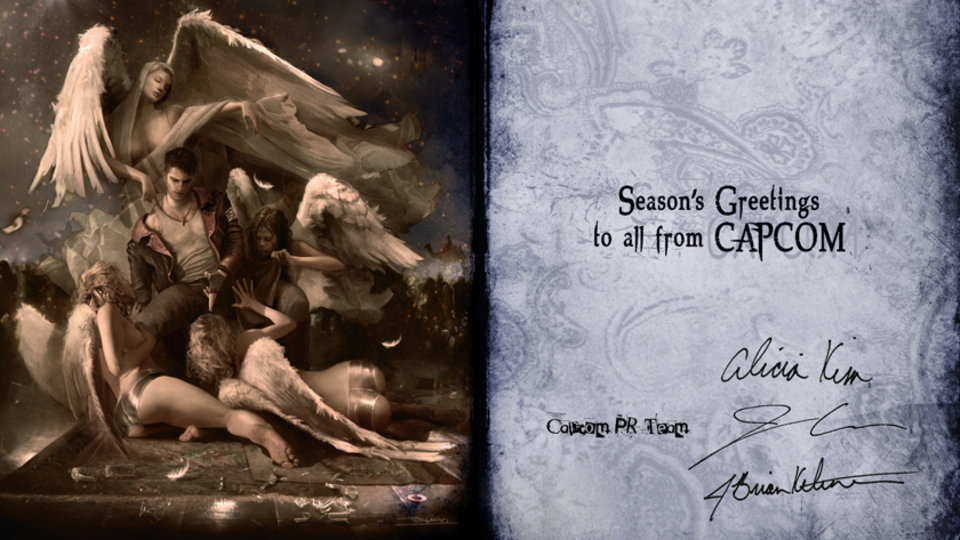
That, right there, is the Christmas card that Capcom PR sent out this year.
Not only is Dante--that charming fellow on the left, there--surrounded by angels, but the angels are, of course:
- women
- light-skinned women
- big-busted light-skinned women
- big-busted light-skinned women with hourglass figures
- big-busted light-skinned women with hourglass figures and prodigious, posed posteriors
Wow.
I didn't care about Capcom until now. But as of today, they're on my personal shit list--there to remain, I suspect, more or less permanently.
Well done, Capcom PR!
Sunday, December 2, 2012
Go read this
File under, "I really wish I had written this:" Katherine Cross's "Game Changer."
Cross does her homework and her research, and articulates very clearly and cleanly the theories that I--and anyone else who examines sexism in gaming--have bandied about for ages. She even looks at the moving goalposts: if women like it, it is no longer a "real game."
It is hardly surprising that some men perceive the gaming world as, in Kimmel’s words, a “virtual men’s locker room” threatened by the presence of women. When women inhabit this space, claim visibility, and attempt to shape it, their presence becomes an existential threat to that “not PC” safe space that some of these young men enjoy. When abuse occurs, the conceit is that it’s “just a game,” which enables people to—in the words of one of Kimmel’s interviewees—“offend everyone!” It’s not like real life, which is too, well, real to risk flagrantly violating norms of decorum. But, at the same time, these male gamers know that the space is a real, tangible thing, in need of protection. Their “offending” serves to police the boundaries of who can and cannot inhabit gaming culture, and to keep out people who threaten “their” space.
Cross does her homework and her research, and articulates very clearly and cleanly the theories that I--and anyone else who examines sexism in gaming--have bandied about for ages. She even looks at the moving goalposts: if women like it, it is no longer a "real game."
Thursday, December 1, 2011
The Golden Days
It's a balmy spring day in New England, almost certainly in 1988. It's late April, probably; the air smells of mud and grass and growing things and we unruly kids have been sent to go play outside. I'm at Tommy's house, on the next street over from mine, and some other kids -- one each of our two neighborhood Matts, Brians, and Corys, and Brendan (my later first crush) -- are there too.
We're on the swing set, playing Ghostbusters until we get bored and someone announces we should play pirates instead. I pick up a well-balanced stick and give my mightiest "ARRRR," until one of the boys says: "No, you're the princess. Girls can't be pirates! We need to rescue you."
I hit him with my stick for a while and claim it's "fencing." Eventually a truce is reached and a compromise made: I'm the Princess Pirate. Childhood harmony temporarily restored, we take to our "ship" with gusto.
You know what "princess pirate" gets you by the time you grow up?
 |
| (Not even close to the most risqué costume image I could have chosen.) |
Also sometime around 1988, these friends started to get NES systems as Christmas and birthday gifts. (I got mine in very late 1993.) One day, I asked for a turn at Mario after one of the boys botched a jump and had to restart his level. It was a no -- but rather than "it's my turn still" I got, "Do girls even play Nintendo?"
Well, this girl would have. And years later, when I could buy my friend's used NES for $25 with my saved-up babysitting money, I did.
This past month has seen a lot of social justice talk in the broader, mainstream game-sphere. Kotaku, whether through a desire purely for pageviews or through a desire actually to engage with the world-that-is, has (re-)published must-read, knockout pieces by Denis Farr, Leigh Alexander, and Mattie Brice that collectively have stirred up nearly all of the bottom-feeding muck and slime to be found in the gamer community. On top of all that, this week writer Tom Bissell is in the news, first for having been offhandedly sexist for no reason and second for having issued one of the better public apologies I've ever read.
Naturally, there's a lot of push-back. Any discussion of gamers who are female, any kind of queer, any race other than white, or indeed any other non-dominant population tends to kick up a fuss. Some of it just goes under the heading of trolls, or "haters gonna hate." But what's most disappointing and frustrating to me is when gamers who could, in theory, be allies say: "Why don't we just talk about the games? Whatever happened to having game sites just be about games already?"
 |
| A selection of Kotaku comments |
It's not necessarily done as an intentional derailing tactic (though it is above), but the effect is just the same. In short, it tells a whole set of players that our experiences don't matter.
 |
| For clarification from Dennis, see below. |
Because for many of us out there who aren't the "right" sort of gamer? It has never, ever been "just" about the games. From age seven, in second grade, when the boys in my class asserted that girls don't play Nintendo. To age seventeen, in high school, when despite using a girly alias and telling everyone I was a girl, the guys all called me "he" when I won science-fiction trivia games. To twenty-seven, when I started to understand that just because my Lone Wanderer looked female, didn't mean the game's design treated her that way.
"Can we just play the video games?" Sure. As soon as conscious and unconscious sexism vanish from the stories, the art, and the reviews.
Culture exists, and we all must live in it. Our culture means that if you're the girl at the party, you might have a really hard time getting the guys to let you in on GoldenEye. It means that if you're the girl behind the counter at the GameStop, you have to deal with a constant level of leering and commentary that your male co-workers never get. And if you're the girl, it means that any time you try to talk about the uphill battle, you're going to get smacked right back down.
The end result is exhaustion. Swimming upstream against culture is tiring. And journalist Tracey Lien is right: it's not just one incident, or just one joke. It's every last one of them. For many of us, life is a pile of these. There are no "simpler days" to go back to.
Bingo.
 |
| source |
The ability never to be alienated by the games we play or by the people who play them is the very core of privilege. Bust out that p-word and gamers get riotous, but there's no way around it. Despite all of the crap that's been handed to me over the last three decades, I have privilege by the metric ton. I'm as white as white can be, identify perfectly well with the sex and
gender I was born with, and have almost exclusively heterosexual
attractions. In those senses, I'm pretty thoroughly represented in game worlds, plots,
narratives, and characters. Further, I have two good hands, two good
eyes, and two good ears -- so I'm pretty thoroughly catered to in terms
of game mechanics, audio-visual design, and control schemes. For a number of my friends and peers? The layers of crap to deal with just never end.
The golden days of everyone being able to "just play a game," if any such days exist, are ahead of us still, not lying dormant in some sepia-tinted past. They are the same as the golden days of all our other pop culture and pop art: lying in a society that's come to terms with understanding sex, gender, race, and a whole lot more.
Wednesday, August 31, 2011
Let's talk about sex!
I had an unexpected amount of video game time to fill, this past weekend. After an hour of Bastion and an hour of Chrono Cross I cast about for something new, feeling at odds. What I really wanted to play was Mass Effect 3, and that's physically impossible for another six months. I tried other games as a distraction but none of them actually satisfied my craving, no more than a bag full of carrot sticks actually satisfies a craving for a bag of chips.
Everyone on Twitter gave helpful, thoughtful suggestions for what I should try, and in the end I ignored every last one of them and got sucked into a marathon six-hour session of Fable III.
 |
| This is my pretty pretty princess, kicking your ass. She had a piratey hat but NPCs made fun. |
Fable III isn't exactly challenging, as far as game play, story, or game design go. And yet, it has challenged me in a most unexpected way. I knew, offhandedly, before I started playing that this was considered a "mature RPG." And yet I was surprised (pleasantly so, but still taken aback for a moment) to find that among the character attributes for nearly every adult NPC in the game, there is a sexual preference qualifier.
The game was telling me, bluntly, in no euphemistic or uncertain terms, which of the characters I was interacting with were straight or gay -- and, by extension, letting me know up front which men and women were considered to be in the dating pool for my character.
Knowing all of this, and knowing how the Fable franchise prides itself on a choices-and-consequences approach, I was still surprised further to discover that the bed in a player's house can be interacted with -- and on interacting, the options are "sleep" and "sex." Sleep has essentially an alarm clock option, and sex can be chosen in the protected or unprotected varieties.
I am in my thirties and have been playing video games since the middle of the 1980s, and this is the first time I've ever seen the existence of sex, as an event unto itself, so explicitly and practically addressed in my pixels.
To be sure, I have played my fair number of games that contain romantic interludes, or the plain ol' bumpin' of uglies. Divine Divinity contains an unmarked quest for finding the main city's brothel, and rewards a large amount of XP for employing services therein. (The brothel in question has both male and female staff, and the player character can pick either, without comment and with equal experience awarded.) Then of course there are the just-barely-offscreen quicktime event shenanigans in God of War (I, II, and III), in which Kratos turns his ragey gusto toward anyone with boobs for a time.
 |
| I ship this so hard, but I'm actually grateful for the fade to black. |
Indeed, the fade to black is what I'm used to seeing in games (with "suggestive offscreen noise" its crass and less-often seen cousin). We all know how this goes: provided you've said the right things throughout Mass Effect 2, someone comes up to Shepard's quarters during the last quiet moment on the Normandy, they exchange a few more words, there's some suggestive motion, press "F" to continue, and it's the next morning. (Relatively speaking, since they're in space...) The romance option with Liara in the first game was much more explicit, but even so, probably less tawdry than many R-rated movies I've seen.
It's actually just as well that ME2 fades to black; if, later, you choose to call your special someone back up to Shepard's quarters, the "couch" and "bed" animations might actually be the most awkward, least natural, most static, least romantic, and least sexy interactions on Earth. Even as PG rated cuddle sessions, they fail.
 |
| It's not just a body-shape thing; male Shep with Tali is equally wretched but you can image search that one yourself. (Warning: don't image search that one.) |
Still, the real surprise for me with sex in Fable III is not that it exists; sex is implied in plenty of games. The surprise is that its existence is announced independently. By adding "sex" to the bed options, and indicating NPC sexual orientation (and flirtatiousness levels) in info boxes, the game is putting out there the idea that sex is a thing your PC might do for any combination of fun, profit, and love, depending on any number of whims, emotions, and circumstances.
Almost like the real world, there. How novel!
Now, I know I'm late to the discussion, and I haven't played Fable or Fable II. (I was interested in Fable II but there's no PC port and likely never to be.) I knew going in that a wide array of player choices existed in the game, but "vague understanding they exist" and "actually having a choice in front of you to make" are two different things.
For what it's worth, my Princess hasn't shacked up with anyone yet, mainly because she hasn't met a soul worth her time. Most of the NPCs she's encountered and interacted with are neither attractive nor interesting, so "friend" is more than enough work there. (Also I can't actually find the way back to my house, which was free DLC content and doesn't appear on the world map that I can find. I may need to buy an apartment in town.) I certainly have no moral objection to my character having (safe, consenting) sex.
Once again, though, I've been surprised by the baggage that I the player bring into this world with me. Although its wardrobe cues are drawn from the 16th - 19th centuries, Fable III takes place in a version of the 1820s that never existed, where most fantasy RPGs take place in a version of the 13th or 14th centuries that never existed. Its "Albion" is yet another false Britain, and so I find myself instinctively guarding against the roles reserved for women in the Georgian and Victorian eras. In that environment, I feel that marriage is not actually an option for my female character. In order to remain a successful, independent, respected agent, my gut says she needs to stay single.
These are totally assumptions I the player bring to the world, and really I only notice and question them because I take the time to write here. I mean, as mentioned, I have no problem pairing off my Shepard. Yes, I felt that not only did she have the burden of representing humanity to the galaxy, but also of representing women. But when forced to examine it, I find that in a sci-fi, future-based environment, I feel that a woman can be partnered and yet also successful and respected. Plus, the Commander was a renowned, accomplished hero in her own right before a partnership option entered her life. She has a strong identity and can keep being herself, and the world in which she lives will support that.
Intellectually, I'm keenly aware that this Albion is not actually England in the dawn of the Industrial Age. I know that it's a game in which I can make any choice the mechanics allow, and still reach one metric of success as a player. I'll be able to complete the story regardless of the side-choices my Princess makes. But in my gut, I still feel the pressure of a few centuries' worth of feminist issues.
Realistically, I don't actually think the mechanics of the game will enforce any kind of social penalties for marriage. Based on what I've seen so far, the biggest impact on the overall story arc I can imagine is NPC gossip and chatter around me in towns. But this unnamed Princess is right now forging her place in the world. She's trying, very hard, to become a leader and to earn the loyalty of an entire kingdom through hard work and hard fighting. She's aiming to place herself at the very head of a nation-wide rebellion to oust her lousy brother, who's a terrible king. That's no small task!
And yet while I feel that a permanent partner (even with divorce easily available in-game) would hold this nameless lady back, I'm not at all averse to her having some sexual interludes for fun, if the right NPCs show up. Somehow I don't feel that the Princess openly having gentlemen or lady visitors will set off any actual consequences with her people (though they may gossip); we'll consider this the "never existed" half of the culture.
Sex in games (and everywhere else) has a way of falling into a certain trap, though. Alex Raymond wrote a really interesting piece a while back on how video games perpetuate the commodity model of sex:
To give an example: a guy I know once received a call from a couple of his friends, who asked if he wanted to go to a strip club. He said something like, “Why would I want to go to a shady bar and pay a random stranger to show me her boobs when I can have sex with my girlfriend?” And his oh-so-clever friends informed him that Hey! When you think about it, you are still just paying to see boobs! Except the payment is in dinners and dates and compliments, rather than dollar bills.
Ha. Ha. Get it? Because all women are prostitutes. ...
So what does this have to do with video games? Well, some video games allow the player character to have sex with NPCs; even more allow the player to have romantic relationships with NPCs. What the vast majority of these games inevitably do is present relationship mechanics that distill the commodity model down to its essence–you talk to the NPC enough, and give them enough presents, and then they have sex with/marry you.
This design approach is extremely simplistic and perpetuates the commodity model of sex–the player wants sex, they go through certain motions, and they are “rewarded” with what they wanted (like a vending machine). Furthermore, when sex is included in a game, it is generally framed as the end result–the reward–of romance, rather than one aspect of an ongoing relationship/partnership. For example, one gamer commented that the romance in Mass Effect seemed like the romantic interest was really saying, “‘Keep talking to me and eventually we’ll have sex’”. The relationship is not the goal; the goal is the tasteful PG-13 sex scene. The NPC’s thoughts and desires aren’t relevant; what matters is the tactics you use to get what you want. This is a boring mechanic in games and dangerously dehumanizing behavior in real life.
Fable III is most certainly and emphatically guilty of what Alex describes; the mechanic of all relationships in the game is purely an item-exchange, level-up sort of thing. And yet it actually feels more like a free choice than in most other games I've seen. Although mysteriously my assumptions about marriage in-game are framed by a historical understanding of the 19th century, my assumptions about sex remain grounded firmly in the 21st: any number of adults can do whatever they all willingly and openly consent to, and should do so as safely as possible.
In pretty much every other game I've ever played, sex for a player character exists in one of two contexts: (1) within a romance arc (not necessarily leading to marriage), or (2) as a literal commodity, traded for money or information. The avatars I've controlled have encountered a number of sex workers in their times and likewise my player characters have on occasion used seduction as a tool to advance. But sex as a choice, with a willing partner, just because we're both there and it seems like fun? Not so much.
This, then, is the paradox I find. While sex in Fable III is to every pixel a tradeable, level-able commodity, it's also a free and open choice, presented without judgement. If there is a "doing it right" to be found, I'm certain this game isn't it -- but it's also, in a strange way, closer.
With the recent release of Catherine, "how does game design approach actual sex and actual relationships?" is a question flying around criticism circles at the speed of the Internet. In almost all cases, I think that answer is still, "badly," with a chaser of "inadequately." Ultimately, all of our games still rely on sets of numerical mechanics and rules. They're a series of unbreakable "if, then" statements and our heroes (and villains) can't decide to take a left turn to the established rules of reality the way a flesh-and-blood human can.
In this one small way, though, in this one tiny instance, my Princess can break the rules. Maybe the next time I see "sex" as an in-game choice, it will be in a game where the NPCs are actually designed to be characters, rather than a half-dozen fixed sound bites and gestures. Society's head might explode.
*If you hear Salt-N-Pepa singing in your head, congratulations: you, too, are an old. Now dance!
Wednesday, August 10, 2011
Beyond the Girl Gamer 2.2: We all live in a...
Beyond the Girl Gamer: Introduction | 1.1 | 1.2 | 1.3 | 1.4 | 2.1 -------------------------------------------------------------------------------
There are a lot of dead women in L. A. Noire. The entire Homicide Desk sequence of the game is devoted to finding murdered broads, in fact. It seems Los Angeles is just teeming with men who seem likely to strangle their girlfriends and wives, and that drunken dames are just leaping from bars left and right, waiting to be gruesome victims.
I am more okay with this than you would expect.
The casual racism and misogyny in L.A. Noire are never* gratuitous and might, in fact, be mitigated, as compared to some of the realities of the time. This game strives, at its core, to be representational art. Team Bondi / Rockstar went to an extraordinary amount of effort to recreate Los Angeles circa 1947 with as much detail and fidelity as possible. The buildings, the streets, and the fashions are all as close to authentic as the developers could manage -- and so, too, are the attitudes. Even the cases themselves, in classic Law and Order style, are drawn from actual historical events.
 |
| There's actually a reason for photographing a woman's body close-up like an object, this time. |
L. A. Noire is meant to represent faithfully a specific historical era, and it is meant to re-create faithfully (in spirit, at least) a specific art form -- the film noir -- that sprang from the same historical era. Whether or not it succeeds at anything is a matter for debate, but no-one can argue that our current notions of race and gender equality applied 64 years ago, because they didn't. We may still have miles to go, in search of a truly equal society, but the strides taken over the course of the 20th century cannot be overlooked.
And in fact, the game is based on the notion that its audience have, indeed, come through the 20th century understanding that violence against women is bad. The designers count on the player having a certain reaction to the cases Cole Phelps is called upon to solve and to the story of Cole Phelps himself. The intentional anachronism in the game is that 1947 Los Angeles is being measured against 2011 mores.
The playability of L. A. Noire relies on the difference between "contains" and "condones." The space in time, and the space in cultural evolution over those decades, are a required baseline for understanding the game's subtext. We are meant to understand that a character's attitude toward non-white citizens, or his attitude toward women, is part of the story of this character. And we are meant to understand that rudeness and cruelty are signals: a cop's brushing off "dames" and insisting he have his way are signs to us within the context of the narrative that this man is A Problem.
 |
| Roy Earle is, how shall we say? A world-class asshole. |
That is the defense I can mount of visible racism and sexism in a game world: sometimes, it really does tell a story. But having provided this "it's okay" discussion of L. A. Noire standing how it does, and having its own merits, we now need to ask the uncomfortable questions. Highest among them is this: why is this the story we always tell?
Gaming has the potential to be anything. A completely digital, completely constructed world can be anyplace we choose in time and in space, with avatars that look like anything and anyone. We can inhabit settings as far-flung as the human imagination can conjure. So given that a true historical drama is going to need to confront the unpleasantries of history -- why are we always plumbing the same histories?
For all that we can tell any story in a game, usually our western-developed stories -- of all play-type genres -- tend to be set in one of a few archetypal worlds:
- High fantasy
- Low fantasy
- Space opera style science fiction
- Near-term science fiction
- Modern urban (Grand Theft Auto, Heavy Rain)
- Fictionalized History (Red Dead Redemption, L.A. Noire)
- Modern Military or Military-esque (Tom Clancy games, Modern Warfare, Battlefield 2)
- Historical Military or Military-esque (every WWII game ever)
There are more, and obviously, these genre-classification walls aren't absolute, but I think they are the biggest buckets and manage to catch a hefty percentage of narrative games. (Some games arguably combine world-types, as well.)
But historically-themed games are not, generally, among the worst offenders. (Indeed, the Assassin's Creed franchise handles women in a plausibly-recreated renaissance Florence and Rome better than I would have expected.) The bigger problem, instead, shows up in our most fictional universes. Gender roles, expectations, and stereotypes common to our history and to our present-day worlds have this amazing way of persisting through worlds that are fully constructed, have never existed, and are not ours at all.
While I was working on this piece, a deeply relevant essay appeared at the Border House. In The Skyhook Society, Quinnae describes this phenomenon:
It is hardly groundbreaking at this point to say that the social worlds painted in many video games and other fantasy environments tend to be based on politically charged ideas about gender, race, and so forth. Despite being wildly fantastic or surreal they are, just as often, presenting the player or the reader with a social world that is depressingly familiar. A world where the humans are white, where the power holders are men, where heterosexuality remains compulsory, where any sort of trans-ness is not even on the horizon; in other words a world with very familiar relations of ruling.
She goes on to describe how the deep-seated and often unexamined need to replicate real-world power structures in fantasy worlds can render them structurally incoherent. The core of her argument is a call for more thought put into the construction of gaming worlds, and less "default" behavior in general.
Even a game that has some excellent tendencies within, in terms of race and gender, can fall down in its universe construction. While taking on the universe from the deck of the Normandy, has Commander Shepard ever met a female salarian? (No.) What about a female turian? (No.) And of course no female krogan.
"There are reasons," one argues. "The salarian matriarchy system! The genophage! Well, Garrus used to have a turian girlfriend!"
Even a game that has some excellent tendencies within, in terms of race and gender, can fall down in its universe construction. While taking on the universe from the deck of the Normandy, has Commander Shepard ever met a female salarian? (No.) What about a female turian? (No.) And of course no female krogan.
"There are reasons," one argues. "The salarian matriarchy system! The genophage! Well, Garrus used to have a turian girlfriend!"
Those aren't reasons. Those are in-character explanations for a design choice that a team at BioWare consciously or unconsciously made. Humans, in the future, do indeed come in an array of racial options, and in both male and female versions, but with only one exception (the quarians), this ability to extend the imagination on-screen apparently only covers the human race. Well, except for when you can come up with an entire race of fictional female hotties.
In general, though, I feel the most structurally incoherent societies we see in geekdom are in our fantasy worlds. This is our sword-and-sorcery plane, our modern nerdery made incarnate. Our RPGs pretty much all take place here (indeed, the fantasy setting tends to be one of the unspoken markers of the genre). The high fantasy universe is easy to mock because it's so ubiquitous. Post-Tolkien and post-Gygax, we're all familiar with the tropes of orcs, elves, and a version of the British middle ages that never was.
 |
| Justicar Samara, older than the city of Boston, will kill you with her cleavage. |
In general, though, I feel the most structurally incoherent societies we see in geekdom are in our fantasy worlds. This is our sword-and-sorcery plane, our modern nerdery made incarnate. Our RPGs pretty much all take place here (indeed, the fantasy setting tends to be one of the unspoken markers of the genre). The high fantasy universe is easy to mock because it's so ubiquitous. Post-Tolkien and post-Gygax, we're all familiar with the tropes of orcs, elves, and a version of the British middle ages that never was.
A game can include female characters galore, and yet still find itself an example of incoherent world-building that doesn't take gender or sex into account in any way. Divine Divinity and Divinity II are guilty of this: you can create a female Divine in the first game and name her anything you like, yet by its sequel, the hero of the first game is canonized as Lucian, a goody-two-shoes of a man if ever there was one. The first game mainly portrays female NPCs as servants, nobles, locals, or witches -- and though not ideal, this is at least theoretically consistent. By the second, nearly all groups, factions, and character types are a fairly hefty gender mix. Men and women both guard town walls, or oppose you with malice (i.e. swords), or are dungeon bosses. And yet women who get lines or quest segments are still mostly there to be plot devices, rather than to be characters with agency. Your player character can be female, and yet nearly the entire game is designed around the responses of a male player character. Simply put, the player can't afford to think about any of it too long, because none of it makes sense on examination.
But the Divinity games really aren't about deep storytelling; they're about getting an awesome weapon and some awesome skills and slaughtering orcs and trolls 'cause they're there. Fair enough. On the other hand, Dragon Age is indeed about a deep narrative, and a carefully built world. In the interest of full and honest disclosure: I still haven't been able to make myself play Dragon Age: Origins. I started to and got bogged down in gameplay mechanics that I strongly dislike. But Kris Ligman has played it, thoroughly.
In a really solid piece about this kind of incoherent society, Ligman gripes about half-thought-through world-building, as it applies to class. Her character of choice was a dwarf, a member of a despised underclass. The player character, of course, rises to fame and power and general badassery, because that's the game we play. It's what RPGs are for. But although she intentionally created a very specific kind of character, the game failed to follow through on any promise of coherent recognition:
The culture of medieval Britain was indeed rigid in a certain way. So was Rome, or the Tang Dynasty. So is 21st century Manhattan, or19th century Paris. But any world in a game is none of these places. Any world in a game is an intentional, theoretically thoughtful construction by a 21st century team of writers, artists, and coders. So why do these fictional worlds keep clinging to real-world biases?
But the Divinity games really aren't about deep storytelling; they're about getting an awesome weapon and some awesome skills and slaughtering orcs and trolls 'cause they're there. Fair enough. On the other hand, Dragon Age is indeed about a deep narrative, and a carefully built world. In the interest of full and honest disclosure: I still haven't been able to make myself play Dragon Age: Origins. I started to and got bogged down in gameplay mechanics that I strongly dislike. But Kris Ligman has played it, thoroughly.
 |
| In all fairness, most characters, even the ladies, wear way more than she does. |
In a really solid piece about this kind of incoherent society, Ligman gripes about half-thought-through world-building, as it applies to class. Her character of choice was a dwarf, a member of a despised underclass. The player character, of course, rises to fame and power and general badassery, because that's the game we play. It's what RPGs are for. But although she intentionally created a very specific kind of character, the game failed to follow through on any promise of coherent recognition:
No one cares where I’m from, only that I look damned heroic right now. ... [T]hough several game narratives exhibit an awareness of class, race, and the intersections of those two, the games themselves as systems display an exasperatingly predictable upper middle class image of social mobility, reliant upon fantasies of self-made wealth achieved at the expense of others and the local ecosystem.Although she's writing about the incoherence of class markers, the truth persists with all out-of-"norm" characterizations in most games. The NPCs are perhaps the result of a coin toss, but they all behave and are written in a way that results in world structures that don't hold up, or that show a lack of imagination.
The culture of medieval Britain was indeed rigid in a certain way. So was Rome, or the Tang Dynasty. So is 21st century Manhattan, or19th century Paris. But any world in a game is none of these places. Any world in a game is an intentional, theoretically thoughtful construction by a 21st century team of writers, artists, and coders. So why do these fictional worlds keep clinging to real-world biases?
The long and the short of it all is, I can only second Quinnae's challenge to game designers (and in fact to all creators of fiction):
Ask yourself critical questions about the division of labour, ethnicity, and gender. Ask yourself if heterosexuality needs to operate in your world exactly the same way it operates in ours. Ask yourself if your culture needs to be an appropriating parody of a human culture, or if every human in your world must be white. Demand of yourself explanations for these things. What you will be weaving in the process is a proper social structure that can hold up your world, one that will almost automatically make it notably different from our own. It will put your world’s various power dynamics at a tantalising remove from our own, making it feel all the more creatively alien and unique. The most interesting fantasy worlds I’ve seen are ones that do make some kind of accounting for their social systems, that possess identifiable structure, rather than unsupported mirroring of the real world.
---------------------------------------------
Related reading: Tanner Higgin, The Trap of Representation
*Caveat: we are, at present, only halfway through the Vice desk and still have probably a third of the game to go, if not slightly more. If some crap does get gratuitous as the game concludes, you can rest assured that I will have a great deal to say about it.
Thursday, August 4, 2011
O Commander, my Commander...
After a brief lull, BioWare's Mass Effect 3 marketing efforts are back in the buzz this past week. I've been quiet on the topic so far, because I knew my knee-jerk reactions wouldn't help the dialogue along in any way, and I needed to think long and hard to sort out my feelings on it all.
So in the meantime, I've been doing some reading. Stories about the Facebook vote and its outcome are all over the web, and a few have resonated with me. I feel that each article I read raises at least one valid point, but that each also manages to miss another point. In total, I think the sum of stories I've seen around the web finally gives me a launch pad from which to write.
 |
| Default DudeShep, via BioWare's website |
Until now -- and still, for the time being -- this guy here has been the face of Commander Shepard. Despite the wide variety of faces a player can see, despite the fact that a player can immerse him- or herself in the Mass Effect universe for 50 or 100 hours without ever once hearing Mark Meer, this character has been the face of Shepard as far as all marketing is concerned. He graces the covers of both game and soundtrack. He is in trailers and commercials. He, in all his white, male, muscular glory, has been Mass Effect to everyone who hasn't played it, as well as to a number of folks who have.
However, we've known for a month or two now that in response to overwhelming fan demand, BioWare / EA have consented to add a little something to the marketing for Mass Effect 3. The other half of Commander Shepard is getting her own trailer, and her face will be on one side of the collector's edition of the game. Fantastic! Equal representation, right? But this created a question over at BioWare: whose face? What does a default female Shepard look like?
Despite the fact that BioWare had no trouble coming up with a default white male space marine on their own, they felt the need to toss this question to the masses. Their marketing / social media team placed six potential Commanders Shepard into a photo gallery on Facebook, so that Facebook fans who "like" the game could vote on their preference. In an interview, David Silverman said that this tactic was their response to the "fan devotion" that had created the FemShep movement in the first place. The fans created the pressure for BioWare to alter their marketing, and so the fans, it seems, must bear the burden of what inevitably follows.
The "beauty pageant" aspect of the Facebook vote has been praised, condemned, blinked innocently at, and sorted through. In a piece of news that virtually everyone and their grandmother saw coming, the conventionally attractive white, blue-eyed blonde seems to be the winner of the contest.
 |
| Get used to this lady; seems she's about to be Commander Shepard. |
None of the available options felt entirely right to me. At first I thought it was because none of them were "my" Shepard, but over time I realized that actually, it has much more to do with their facial features and hairstyles overall. All of the Commanders on display looked unfamiliar to anyone whose primary experience is with the Mass Effect and Mass Effect 2 character creation system, just as released photos of Ashley Williams from the third game look unfamiliar to anyone who encountered her in the first or second.
So I was willing to overlook a certain level of detachment with this Commander Shepard. I certainly don't have anything personal against this particular image; she's fine. She's a video-game character, taking on the role of action hero. Even of the six available and unfamiliar options, though, she's not the one I would have picked. Despite my Shepard looking like an aspirational, gamer-ego self-insertion version of me (ultra-pale, with red hair), of the available voting options and for marketing purposes, I preferred Shepard number four (who in fact holds second place in the voting):
 |
| And no, not because of the red streak in her hair! |
Regardless of which face Shepard wears, I appreciate that she stands in the exact same pose, with identical weapons and (anatomy permitting) armor to her male counterpart. One of the most remarkable things about this franchise to date has been the complete equality of both versions of Commander Shepard. The game, required to accommodate both characters, has been unable to go off the rails into hugely gendered territory in either direction. When it comes to writing and to character animation, the existence of each Commander Shepard keeps the other in line. The Commander can't have any specific issues related to gender or race, because of the choice in the player's hands. Lesley Kinzel summed it up incredibly well, while writing about her Shepard:
These games were not written specifically with a woman, much less a woman of color, as the protagonist. At best they were written to be gender- and race-neutral, or at minimum they were written as the cultural default (i.e., white and male). Either way, the story lacks the encoded racism directed at characters of color in even the best of media representations.
When Brown Lady Shepard is rude, or curt, or dismissive, the reactions she receives from others are not to her gender or her race, but to her words. Why? Because the character was written with the expectation that most people will play it as a white dude, a character for whom reactions based on gender or race are inconceivable. He’s “normal”, y’see. In real life, and in most media representation, we are culturally conditioned to respond differently to a big ol’ white dude with no manners than we do a woman of color doing the exact same thing.
I have a completely unprovable feeling, deep down, that someone at BioWare knew before posting a single picture which of the six Shepards would win the contest, or at least knew that the redhead and the blonde were the two most likely candidates. What I can't help but think, when I read Silverman's interview, is that "throw it to the fans" was BioWare's chance to avoid the responsibility for that choice.
As pleased as I still am that there's going to be any female representation in the marketing of Mass Effect 3, this feels like BioWare's way to have their cake and eat it, too. The character being chosen is exactly one that the team who came up with the default male Shepard could have picked entirely on their own, but this way they get to absolve themselves of doing so. It's what "the fans" wanted, after all, and if many of those fans represent the absolute worst of the misogyny inherent in gamer culture, well, it doesn't actually matter.
Astonishingly, Jerry "Tycho" Holkins, of Penny Arcade, was right, when discussing this. (The gents at PA have a less-than-stellar track record of dealing with gender issues.)
 |
| The comic makes a perfectly good point - it's just the wrong point entirely for the discussion. |
Tycho wrote: "It’s one of these online shitstorms in certain quarters now, people don’t like how it shook out, or who might have shaken it out. That’s the trouble with democracy, huh? The wrong people are always voting." And it's true: none of us can really look at fans of a game voting and honestly claim that some should have a say, and others shouldn't. If you're going to let the player base have a say, then all players should have an equal chance to raise their voices.
The question is: should the player base really be having a say at all? Writer Dennis Scimeca has wisely observed:
Gamers who play as FemShep are intensely attached to the character. She has inspired numerous fan videos on YouTube both inventive and hilarious. Websites have been created to celebrate her. She has even taken a symbolic role in the social justice community.
This devotion is what made an open vote on her official depiction so puzzling to me. That devotion comes from only 18% of Mass Effect players. Allowing votes from the other 82% who have no vested interest in a depiction of a female Commander Shepard feels like disrespecting the dedicated fans who made this marketing campaign happen, by drowning their voices in the noise of the mob.
I've realized: that's the crux of my discomfort. At first I thought it was personal -- I felt like something special to me was being invaded by an unruly horde, and I felt that it was on me to grow up and get over it, because I have no personal claim on any of it.
To a certain degree that is, admittedly, true, although I never needed or wanted to see specifically my Shepard on the box. But the thing is: it doesn't really matter which Commander Shepard is chosen. The actual problem runs far deeper than this leading lady. The problem is that once again, as seems to happen so often in our society, a female body and a female appearance have become a matter of public debate and public determination. Shepard may be a digital construction, rather than a real woman, but she has still just become the subject of a popularity contest -- and, yes, a beauty pageant -- for a majority male audience.
The issue is not that Commander Shepard is a blonde; the issue is that she is and remains FemShep. That's what the Penny Arcade strip missed. She is still the other. When Shepard is a woman, she is not a default anything and BioWare won't position her as such. Can you imagine if she had always been on the box, and if DudeShep were the one a fan campaign had finally brought to prominence? Where is the world in which we the fans vote which one of six beefy men to put on the reverse cover?
The frustration I personally feel is not one of betrayal or of disgust; BioWare is, ultimately, a software company. Their job is to turn a profit and to sell as many units of their games as possible, and I certainly don't begrudge their actions. My frustration, rather, is of lost potential. Lesley was right: Mass Effect was a chance for something different. For so many players, FemShep has been something different. And this marketing change was a rare opportunity for something new, for something special.
Instead, we have this supermodel. She doesn't invalidate the Commander. She does, though, return many of her players, who had hoped just this once for something other than the stereotypical Hollywood wet dream, to the margins.
Alas, we players of the badass lady are in the minority, and minority voices are easily overridden. Perhaps there should never have been a vote to start with, but as there was, I can't cry about its outcome. Of course ultimately, it's all so much chaff in the wind. Neither the trailer nor the collector's edition box art affect the game one tiny bit. They never would, never could, and never did.
But BioWare was so, so close. The FemShep campaign took us all three steps forward, and the FemShep Facebook vote took us two steps back. We're still a step ahead of where we were, to be sure, but it could have been better still. I hope to see a "next time" where it can be.
Monday, June 20, 2011
The Gamer's Gaze, part 1
The gaze is a term you hear thrown around quite a bit in critical media studies. It is, at once, both simple and complex.
"Gaze." It's as easy as looking, right? And at its most basic level, that's exactly what the phenomenon describes: who is looking, what is being looked at, and why? All visual arts have, in one way or another, a built-in gaze that can be examined and analyzed.
In the 1970s, film theorist Laura Mulvey brought the term "male gaze" permanently into the lexicon of film criticism. Her essay "Visual Pleasure and Narrative Cinema" [PDF] relies heavily on Freudian theories (even while in a film studies graduate program, Your Critic found this essay a particularly thorny read) but also basically defined feminist film theory. It's a difficult piece from which to pull a key quote or single definition, but I'll run with this one:
"In a world ordered by sexual imbalance, pleasure in looking has been split between active / male and passive / female. The determining male gaze projects its fantasy onto the female figure, which is styled accordingly. In their traditional exhibitionist role women are simultaneously looked at and displayed, with their appearance coded for strong visual and erotic impact so that they can be said to connote to-be-looked-at-ness."
In its most basic, shortest form, the idea is this: on screen, the primary purpose of a woman is as a sexualized (deliberately or not) object, and the viewer for which film is designed is a straight male.
The essay that defines this idea is now closing in on 40 years old, and came out of a different era. I don't think that, here in 2011, I'd ever be inclined to apply straight-up Freudian theory to media analysis. (If I ever do display the urge to do so, please take away my computer.) But the idea of the gaze does indeed hold up, as does the idea of the default viewer.
Here's the thing: it works at a mostly subconscious level. With very few exceptions, a film director or a game designer doesn't set out actively thinking, "I am going to make this to appeal directly to straight white men and everyone else can get bent." Rather, the likelihood is high that the creator himself is a straight white male, and so comes to production with unconscious biases in place, that then are reflected through things like the framing of shots or the motion of the camera. And even if the creator in question is not all three (straight, white, male), the media landscape has been dominated by those elements for such a long time that this perspective is the default, and its point of view may not be challenged.
Thus: the male gaze.
So as we talk about the gaze and the male gaze in gaming, what do we really mean? What are we talking about?
Wikipedia has a nice little run-down of the areas of gaze -- the "who" in "who's looking." The three that are most important to us are:
- Characters' gaze at other characters
- The camera's gaze
- The spectator's gaze
The spectator, in our case, is the person playing the game. Whoever is holding the controller, or gesticulating at the Kinect, or sitting at the keyboard: that person is the spectator. The spectator's gaze is unbelievably crucial to both first-person and third-person narrative games. So important, in fact, that it will be standing alone as a Part 2 to this discussion.
The camera's gaze is the easiest to talk about, and the way characters gaze at other characters is tied into it. We the viewers see how characters see each other by how the camera behaves. This is every bit as true in gaming as it is in cinema, although in modern 3D narrative gaming, character placement and framing also play a large role. (Non-interactive cut-scenes essentially are film, and can be analyzed in the same ways.)
As a general, broad rule of thumb, the way the camera moves around or is positioned on a character tells us something about how we are meant to view that character, both literally and figuratively. Media saturation is now so high in our culture that we're very nearly all born speaking this language of visual cues and ideas.
We know what heroes pose like, and how they're framed. You can actually tell a lot about each character from how he's standing. Ezio's design conveys his positioning in the grey areas of life (he's a good guy by being an Assassin), Supes is, well, Supes, and Snake over there looks straight at you. But note how they all stand: strong, confident.
We know what villains pose like, and how they're framed. They are men of action, in motion, presenting their challenge. And their weapons. And their black costumes and / or hidden eyes.
For us, the issues arise with women, and how they're framed. And so it comes to pass that a super-spy, a world-renowned adventurer, and the galaxy's best thief mainly display their... assets. When they have weapons, they're held pointed toward the floor. They don't stand straight; rather, they pose their hips.
Of course, gaze is constantly in motion (think of the classic head-to-toe scoping out of the hottie across the room), not static. These are all just promotional images, right? So let's go to the video.
There's always Miranda offering her loyalty mission in Mass Effect 2 (00:01 - 01:08):
With Madison, the issues of what we see and how we see it are both in play. The camera is... not shy. (The censored bits between 03:00 and 05:00 are to make it YouTube-safe; nothing's covered up in the game.) For extra credit, watch Ethan Mars's morning shower from the same game. The camera is much less fond of his curvature than it is of hers.
In gaming, the camera's gaze and the characters' get tangled together, because we aren't just viewers, but players. We take on the role of someone in the story, and the camera serves as our eyes. Male characters tend to be the point-of-view characters, even in a third-person game. We watch what interests them. Miranda's deliberately putting herself on display for Shepard. This makes the moment of male gaze particularly jump out if you're playing a female Shepard, as then the on-screen dynamics feel misplaced, rather than feeling like a default.
So when characters gaze at other characters, the camera follows their lead. Hundreds of games do it. The running comment I had while playing through the Metal Gear Solid series (spouse held the controller 90% of the time; I provided the running MST3K-style commentary 100% of the time) was that clearly, working buttons and zippers for women were too expensive for these high-tech organizations.
The other issue of gaze in gaming, however, is made more complex by the interactivity and choice factors in the medium. Heavy Rain is a deliberately cinematic game and so the camera, framing, and direction behave in a deliberately cinematic way. Madison may not have an awareness of the viewer but she will behave for his eyes all the same. But what about another genre of game? How does the gaze behave in an action platformer, an adventure game, a first-person shooter, or an RPG? How does the male gaze function when the lead character is a woman, or when the player has full control of the camera?
As a general, broad rule of thumb, the way the camera moves around or is positioned on a character tells us something about how we are meant to view that character, both literally and figuratively. Media saturation is now so high in our culture that we're very nearly all born speaking this language of visual cues and ideas.
We know what heroes pose like, and how they're framed. You can actually tell a lot about each character from how he's standing. Ezio's design conveys his positioning in the grey areas of life (he's a good guy by being an Assassin), Supes is, well, Supes, and Snake over there looks straight at you. But note how they all stand: strong, confident.
 |
| You work those shoulders, gentlemen! |
 |
| No comment on Sephiroth's sword vs. how happy he is to see you. Such as. *ahem* |
For us, the issues arise with women, and how they're framed. And so it comes to pass that a super-spy, a world-renowned adventurer, and the galaxy's best thief mainly display their... assets. When they have weapons, they're held pointed toward the floor. They don't stand straight; rather, they pose their hips.
 |
| And then of course there's wardrobe design. Lookin' at you, Eva. |
Of course, gaze is constantly in motion (think of the classic head-to-toe scoping out of the hottie across the room), not static. These are all just promotional images, right? So let's go to the video.
There's always Miranda offering her loyalty mission in Mass Effect 2 (00:01 - 01:08):
Or of course there's our introduction to Madison in Heavy Rain (probably NSFW):
With Madison, the issues of what we see and how we see it are both in play. The camera is... not shy. (The censored bits between 03:00 and 05:00 are to make it YouTube-safe; nothing's covered up in the game.) For extra credit, watch Ethan Mars's morning shower from the same game. The camera is much less fond of his curvature than it is of hers.
In gaming, the camera's gaze and the characters' get tangled together, because we aren't just viewers, but players. We take on the role of someone in the story, and the camera serves as our eyes. Male characters tend to be the point-of-view characters, even in a third-person game. We watch what interests them. Miranda's deliberately putting herself on display for Shepard. This makes the moment of male gaze particularly jump out if you're playing a female Shepard, as then the on-screen dynamics feel misplaced, rather than feeling like a default.
So when characters gaze at other characters, the camera follows their lead. Hundreds of games do it. The running comment I had while playing through the Metal Gear Solid series (spouse held the controller 90% of the time; I provided the running MST3K-style commentary 100% of the time) was that clearly, working buttons and zippers for women were too expensive for these high-tech organizations.
 |
| Seriously, Naomi? You're going to leave your boobs hanging out with a kid like that flinging hot food around? |
The other issue of gaze in gaming, however, is made more complex by the interactivity and choice factors in the medium. Heavy Rain is a deliberately cinematic game and so the camera, framing, and direction behave in a deliberately cinematic way. Madison may not have an awareness of the viewer but she will behave for his eyes all the same. But what about another genre of game? How does the gaze behave in an action platformer, an adventure game, a first-person shooter, or an RPG? How does the male gaze function when the lead character is a woman, or when the player has full control of the camera?
In the interest of not presenting a 10-page paper for your Monday morning, the player's gaze is Part 2, coming in the next post.
[Edit: Part 2 is here.]
[Edit: Part 2 is here.]
Subscribe to:
Posts (Atom)